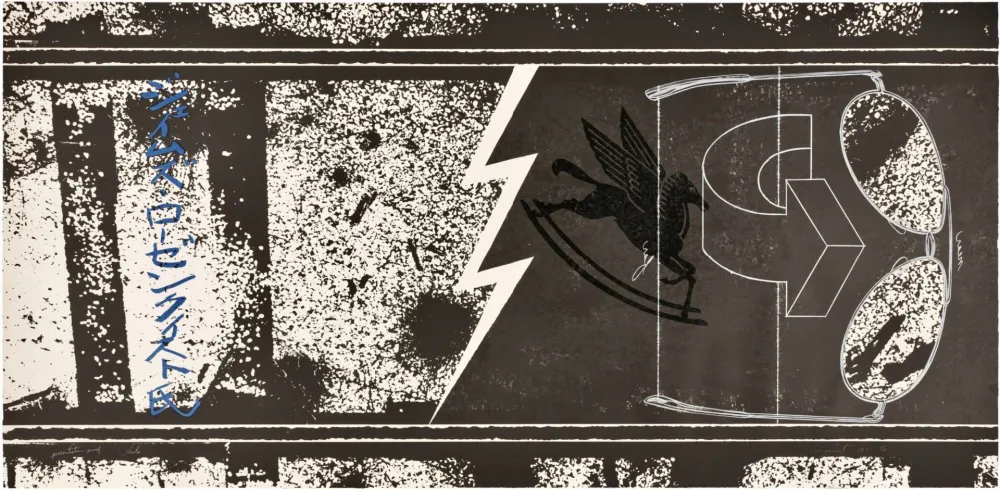
Lithograph and silkscreen
34 1/2 × 70 1/2 in | 87.6 × 179.1 cm
Edition of only 40
Signed, titled, dated in pencil (the edition was 40, 20 in Roman numerals and 3 artist's proofs),
Published by Graphic Studio, University of South Florida, Tampa (with their blindstamp and inkstamp on the reverse), printed in the United States, framed.
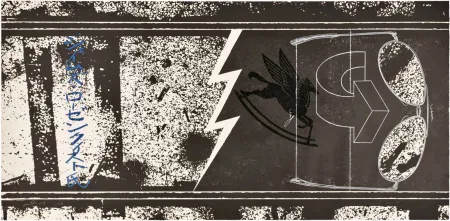
In Rails, Rosenquist used the image of a lightning bolt to slice the composition boldly in half, then created a balance that depends not on exact symmetry, but on the delicate counterbalancing of the visual force of the imagery on either side. The composition has a light left and dark right side that, given Rosenquist’s study of Eastern philosophy, is intriguingly analogous to the Chinese symbol for yin and yang. The artist balances the visual interest inherent in the subtle textures of the railroad track and its gravel bed (for which visual identification comes slowly) against the easily recognizable images of sunglasses and rocking horse. The left side of the composition is given additional visual weight by the insertion of the artist’s name, written in Chinese characters, in blue, the only color among the neutral tones of black, white, and silver. Implied movement is integral to Rails, the railroad track, alludes to “locomotion,” while the split of the lightning bolt, the rocking of the winged horse, and the pair of sunglasses – whose rotation on an axis is suggested by the large arrow indicating movement around the central snapline – are all additional metaphors for motion and energy. (Fine, Ruth E., Corlett, Mary Lee, Graphicstudio Contemporary Art from the Collaborative Workshop at the University of South Florida, National Gallery of Art, 1991.)
Rosenquist, though he drew constantly on the technical image world as a source for motifs, expressed indifference to the internet and eschewed mechanical means of production, maintaining his faith in the human hand and its wondrous abilities as shown by the old masters in works, as he said, “made with minerals mixed in oil schmeared on cloth with hair from the back of a pig’s ear.” His early experience as a painter of billboards had taught him how traditional tools used in a new context and at a different scale afforded entirely new effects. For him, the ancient tools retained infinite possibilities. Major Pop artist James Rosenquist used sign-painting techniques to make kaleidoscopic canvases that conjure American advertising. He embraced the visual language of commercial art, filtering images of shiny American objects through a cool, Surrealism-inflected lens. His paintings, murals, and prints evoke billboards and posters, yet they remain more mysterious and unresolved than any editorial campaign could allow.
Rosenquist took art classes at the University of Minnesota, Minneapolis, before moving to New York and briefly joining the Art Students League. He also worked as a billboard painter.
Rosenquist’s work has been shown in New York, London, Paris, Berlin, Tokyo, Rome, and Los Angeles, and belongs in the collections of the Metropolitan Museum of Art, the Centre Pompidou, the Museum of Modern Art, the Tate, the Guggenheim Museum, Moderna Museet, and the Museum of Contemporary Art, Los Angeles, among others.
His paintings have sold for up to seven figures at auction. This work will be shipped free of charge, if within the US. International shipping will be $150, via DHL.