PABLO PICASSO (1881–1973) & PAUL-PIERRE LEMAGNY (1905–1977)
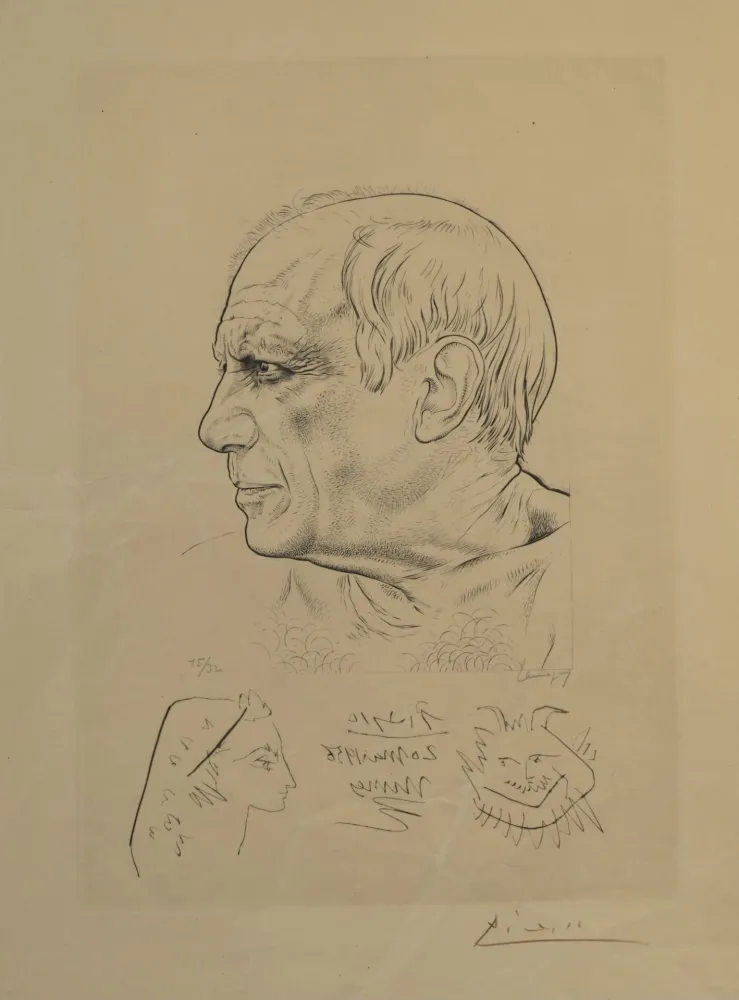
Portrait de Pablo Picasso et remarque pour Témoignage 15/32
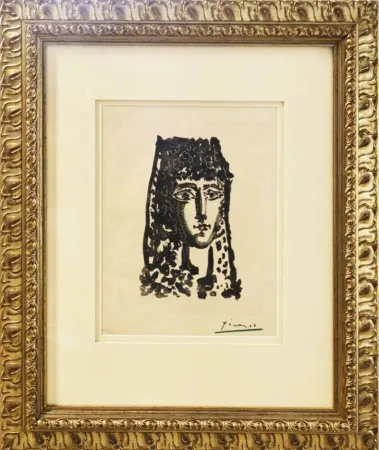
1956 — Original Etching and Drypoint with Picasso's Engraved Remarques
An exceptionally interesting original collaborative engraving by Paul-Pierre Lemagny and Pablo Picasso, created in 1956 to commemorate Picasso's 75th birthday, featuring Lemagny's finely executed portrait of the artist accompanied by original drypoint compositions engraved by Picasso himself.
Artists: Pablo Picasso (1881–1973) and Paul-Pierre Lemagny (1905–1977)
Title: Portrait de Pablo Picasso et remarque pour Témoignage
Date: 1956
Technique: Original etching and drypoint.
Dimensions: Approximately 55.5 × 38 cm (sheet).
Signatures: Featuring Picasso's additional handwritten signature in the lower margin, as well as the signatures and inscriptions incorporated into the engraved composition. The portrait also bears Lemagny's signature near the lower right of the portrait.
Catalogue Raisonné:
- Georges Bloch, Picasso: Catalogue de l'œuvre gravé et lithographié, No. 823.
- Brigitte Baer, Picasso: Peintre-graveur, No. 955.
- Patrick Cramer, Pablo Picasso: The Illustrated Books, No. 80 (reference to the associated publication, Témoignage).
- Miguel Orozco, Picasso: 70 Years of Book Illustration, No. 160 (associated publication).
Historical Background — Picasso's 75th Birthday
The work was created in 1956, the year Pablo Picasso celebrated his 75th birthday, during a period when his artistic reputation was firmly established internationally.
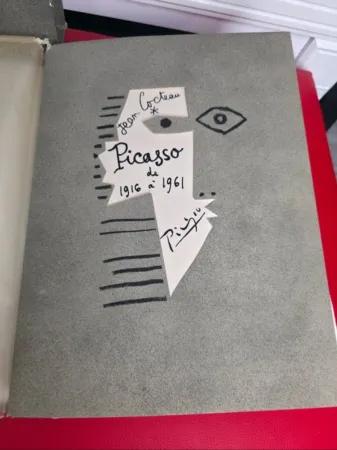
To commemorate the occasion, the French poet, writer and artist Jean Cocteau conceived Témoignage, an illustrated tribute to Picasso and to their longstanding friendship.
The publication, issued in Paris by Pierre Bertrand, was intended as both a personal homage and a celebration of Picasso's extraordinary contribution to twentieth-century art.
The project brought together several prominent artistic personalities, including Jean Cocteau, Paul-Pierre Lemagny and Picasso himself.
Lemagny, a respected French engraver particularly admired for the precision and expressive qualities of his portraits, was commissioned to produce an engraved likeness of Picasso.
The resulting image presents Picasso in profile, emphasizing his penetrating gaze, strong facial structure, distinctive nose and the unmistakable features of the artist in his later years.
The engraving combines delicate etched lines, subtle cross-hatching and carefully modulated tonal passages, producing a remarkably detailed and psychologically compelling portrait.
Picasso's Direct Artistic Intervention
What makes this particular composition especially important is Picasso's personal involvement in the engraving itself.
Rather than allowing Lemagny's portrait to remain an independent work, Picasso intervened directly in its composition.
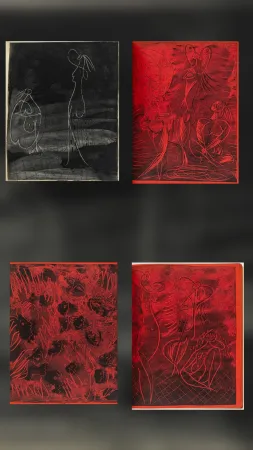
In May 1956, at Nîmes, Picasso added a series of original drypoint remarques beneath the portrait.
These additions include a stylized female profile, a fantastical mask-like face and expressive linear inscriptions, executed in the spontaneous graphic language characteristic of Picasso's work.
Their contrast with Lemagny's meticulously engraved portrait is particularly striking.
Where Lemagny employed controlled, finely detailed engraving to reproduce Picasso's physiognomy, Picasso answered with a few energetic, free-flowing lines.
The resulting composition brings together two distinctive artistic approaches on a single engraved plate.
The lower compositions are not later reproductions of Picasso drawings. They are original graphic interventions made by Picasso directly on the printing plate.
This distinction is fundamental to the artistic and bibliographical importance of the work.
The Significance of the Remarques
In traditional printmaking, a remarque is a small engraved image, sketch or additional motif appearing outside the principal composition.
Such additions may serve as decorative elements, experimental studies or personal interventions by the artist.
In the present work, Picasso's remarques are particularly significant because they transform a conventional engraved portrait into an original artistic collaboration.
The contrast between the highly detailed likeness by Lemagny and the spontaneous imagery introduced by Picasso creates a composition of considerable historical and visual interest.
The engraving documents not merely Picasso's appearance at the age of 75, but also his direct participation in the creation of his own portrait.
Original Handwritten Signature
The present impression is further distinguished by the presence of an additional handwritten signature of Pablo Picasso in the lower margin, separate from the signatures and inscriptions engraved within the composition.
This distinction is particularly important for collectors, since an individually applied signature is materially different from a signature reproduced through the printing plate.
The presence of the signature gives this impression an additional point of interest beyond the original engraved collaboration.
Edition and Rarity
The engraved portrait was originally associated with Jean Cocteau's Témoignage, published in Paris by Pierre Bertrand in 1956.
However, the present work is offered as an individual original engraving, not as a complete copy of the illustrated publication.
The history of the engraved plate is particularly noteworthy.
The original portrait existed in different configurations, including impressions produced before the plate was reduced for inclusion in the book.
The impressions featuring Picasso's additional engraved remarques represent a distinct and substantially more limited group than the ordinary portraits appearing in the publication.
Bibliographical research records limited groups of impressions on different papers, including Japanese-type paper and wove paper.
The catalogue by Miguel Orozco discusses approximately 85 recorded impressions in two numbered groups, comprising a series of 20 and another of 65.
Accordingly, impressions incorporating Picasso's original engraved additions are significantly more restricted than the full publication edition.
Catalogue Raisonné — Bloch 823 / Baer 955
The work is of particular importance because Picasso's contribution is independently documented in the principal catalogues raisonnés of his original graphic work.
Bloch 823 records the original Picasso remarques associated with the portrait engraved by Lemagny.
Baer 955 provides an additional scholarly reference for the engraving and its different states and impressions.
These catalogue references distinguish the work from an ordinary portrait of Picasso created by another artist.
They establish the artistic significance of Picasso's direct contribution to the plate and place the engraving within the documented history of his original graphic production.
The associated illustrated publication, Témoignage, is recorded under Cramer 80 and Horodisch D30.
Artistic and Collecting Significance
This engraving brings together several characteristics of particular interest to collectors of Picasso's graphic work.
First, it is a highly accomplished portrait of Picasso by Paul-Pierre Lemagny, an artist recognized for the technical refinement and expressive precision of his engraving.
Second, it incorporates original compositions engraved directly by Picasso, creating an unusual collaboration between portraitist and sitter.
Third, the work is closely connected with Témoignage, the celebrated 1956 publication by Jean Cocteau marking Picasso's 75th birthday.
Fourth, the composition is documented in two major catalogues raisonnés of Picasso's graphic oeuvre, Bloch 823 and Baer 955.
Finally, the present impression features an additional handwritten signature attributed to Picasso in the lower margin.
An important original etching and drypoint from 1956, combining Lemagny's portrait of Pablo Picasso with original engraved remarques by Picasso himself, documented under Bloch 823 and Baer 955. A distinctive example of artistic collaboration associated with Jean Cocteau's historic tribute to Picasso on his 75th birthday.
Some traces of handling